artykyn:

prideling:

gunvolt:

im going to have a stroke

Instead try…

Person A: You know… the thing
Person B: The “thing”?
Person A: Yeah, the thing with the little-! *mutters under their breath* Como es que se llama esa mierda… THE FISHING ROD

As someone with multiple bilingual friends where English is not the first language, may I present to you a list of actual incidents I have witnessed:

  • Forgot a word in Spanish, while speaking Spanish to me, but remembered it in English. Became weirdly quiet as they seemed to lose their entire sense of identity.
  • Used a literal translation of a Russian idiomatic expression while speaking English. He actually does this quite regularly, because he somehow genuinely forgets which idioms belong to which language. It usually takes a minute of everyone staring at him in confused silence before he says “….Ah….. that must be a Russian one then….”
  • Had to count backwards for something. Could not count backwards in English. Counted backwards in French under her breath until she got to the number she needed, and then translated it into English.
  • Meant to inform her (French) parents that bread in America is baked with a lot of preservatives. Her brain was still halfway in English Mode so she used the word “préservatifes.” Ended up shocking her parents with the knowledge that apparently, bread in America is full of condoms.
  • Defined a slang term for me……. with another slang term. In the same language. Which I do not speak.
  • Was talking to both me and his mother in English when his mother had to revert to Russian to ask him a question about a word. He said “I don’t know” and turned to me and asked “Is there an English equivalent for Нумизматический?” and it took him a solid minute to realize there was no way I would be able to answer that. Meanwhile his mom quietly chuckled behind his back.
  • Said an expression in English but with Spanish grammar, which turned “How stressful!” into “What stressing!”

Bilingual characters are great but if you’re going to use a linguistic blunder, you have to really understand what they actually blunder over. And it’s usually 10x funnier than “Ooops it’s hard to switch back.”

Shipping Questions, Pt. II

random-animezing:

Part I

Which half of your OTP:

  • likes to go on drives to nowhere in particular
  • is in charge of the radio or playlist in the car (and what do they play)?
  • reaches over to hold the other’s hand 
  • is more likely to hog the bed
  • favors lazy morning sex
  • likes to drink their coffee or tea outside in the mornings
  • reads the paper or watches the news
  • feeds and takes care of the stray cat that hangs around the house (and pretty much makes it not a stray)
  • chooses the color of paint for the walls
  • comes home with the weirder work stories
  • takes long baths 
  • has the full skin care routine
  • gives the other a massage when they seem tense
  • is more easily turned on 
  • prefers to kick back with a drink in the evenings
  • stays up too late reading
  • is the deep sleeper 

eerian-sadow:

dynamicsymmetry:

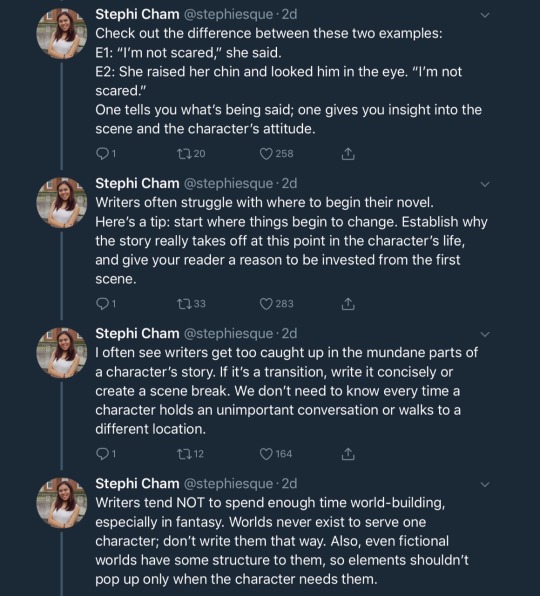
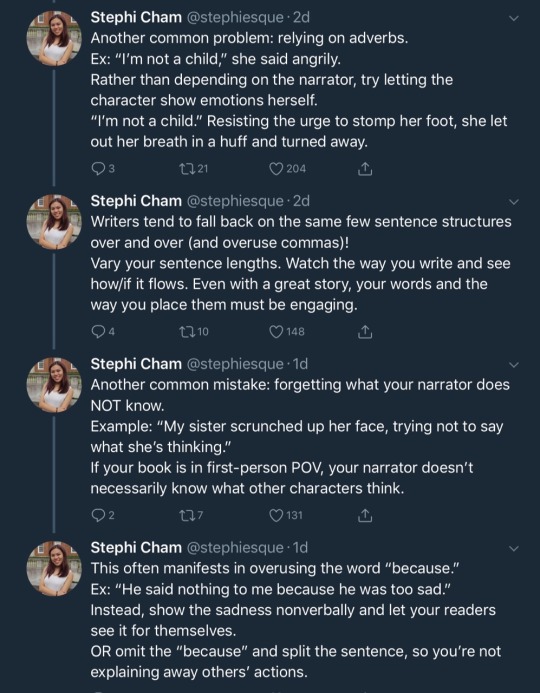
Good stuff.

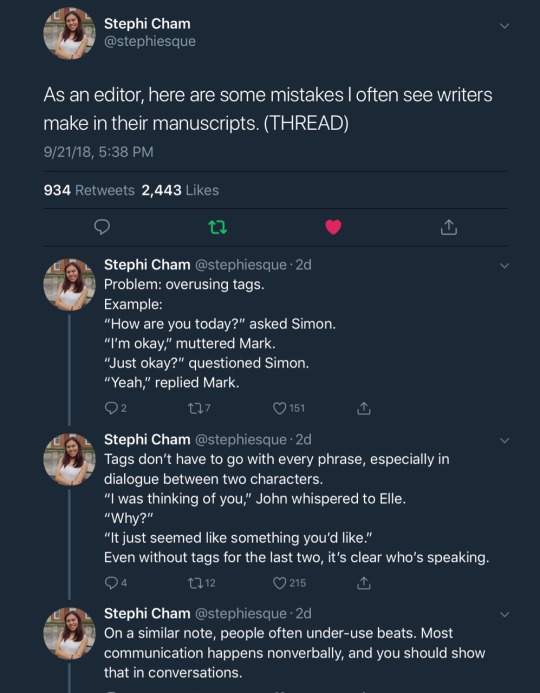
This. This is good fiction writing advice. I really appreciate how it was formatted as “this is a common problem, here is a solution to try in your own work” and not “oh god, don’t do that!” without any extra help. And I extra appreciated the “don’t rely on adverbs” bit, because they do have their place but they aren’t the only way actions can be emphasized.

carolinus-rex:

SMUT

I saw this big master post about all random things, but I found these the most important things and felt the need to separate it from the other topic. I’ve read most of them and I fully agree with them and if your insecure but want to try out things or just want to improve your smutting skills, then I suggest you read these. c:

How to write a kiss

snazzycookies:

Rebloggable version, as requested by davrosbro. 🙂

Oooh!  Yes!  I love kisses.  Kisses are where it all starts ;).

Okay, first, remember that a kiss is much, much more than just lips.  It is lips, but also tongues, teeth, eyes, faces, hands, noses, bodies, heartbeats,  breath, voice- and most importantly, a kiss is emotions.  A kiss without emotion is just wet mushy lips stuck together.  Ew.  Gross.  The most important part of a kiss isn’t the how, but the who– because of the emotions between the two people.

Okay so:

lips– Lips can slide, glide over each other smoothly, or they can be chapped and rough and dry and get stuck on each other.  They can match, top-to-top and bottom-to-bottom, or they can overlap, with one person’s top or bottom lip captured between the other person’s lips (yummy).  If there is lipstick or chapstick there is lipstick or chapstick flavor, otherwise, lips don’t have a taste (can you taste yours?).  Lips also can smack- the sound of two of them coming together or pulling apart, because they’re wet and warm and soft. 

tongueTongues are always wet, and always warm.  They’re very versatile.  They can trace over lips, teeth, or another tongue.  They can be smooth and graceful or teasing and flicking.  When tongues are involved, there is drool.  It’s only sexy when you like the person you’re kissing, or else it’s kinda gross. 😛

teeth– teeth can clack together awkwardly, or teeth can bite down sensually.  A person biting their own lip is cute, a person biting another’s lips is sexy.  A person biting gently is sensual, a person biting roughly is sexual. 

eyes Eyes can be wide open with surprise, half-lidded with desire, fully closed with pleasure.  Eyes can gaze lovingly, lustfully, wistfully, hungrily, seductively- it all depends upon the emotions of your characters.  Have them do whatever you like, but don’t leave them out- give them at least a mention!

faces– Faces are what the lips are attached to.  Noses bump, cheeks flush, ears turn red, foreheads either wrinkle or relax.  Kisses can leave lips, quite easily, and become kisses on chins, cheeks, noses, foreheads, ears, necks, throats.  Kisses on noses or foreheads are cute and adorable, kisses on cheeks are sweet, kisses on chins, ears, and throats are very sexual.  And a kiss on the lips can be all of those! ❤

hands Hands are super-important.  In order to describe a kiss, usually you want to also describe the hands.  Where are they?  Does one character have their hand behind the other’s head or back, holding them close?  Are they on someone’s shoulders pulling them near, or pushing them away?  Fingers brushing someone’s cheek or palms grabbing someone’s ass convey two very different kinds of situations, even if the kiss itself is exactly the same.

noses– Noses are annoying.  They easily get in the way, especially for first kisses!  People have to tilt their head to one side or the other, and if they don’t, noses bump.  I’d only mention noses if a kiss is supposed to be awkward or uncertain or nervous.

bodiesbodies are either close together, or far away.  Someone can be surrounded comfortingly by someone’s arms, or terrifyingly trapped by them.  Bodies are warm or hot, they are calm or nervous, relaxed or tense.  Body language says a lot.  Is your character pulling away, or moving closer?

heartbeat Hearts can beat fast or slow, and that’s about all they can do- but there are lots of reasons why they do!  A heart can beat fast with fear or excitement or nervousness; a heart can pound with lust or race with terror or sing with joy.  Hearts can glow, cower, or shatter.  When you really want to drive the emotions of a character home, mention the heart.

breath– To me, the most consuming part of a kiss is the breath.  The air that someone else has just breathed going deep into your lungs is very intimate.  Lips and tongues don’t have a taste, but breath does.  Each person’s breath tastes different, smells different, and surrounds a person differently than anyone else’s breath.  Breath can be warm and sweet, breath can be hot and sexy, breath can be hot and frightening.  It is something that is very present and should not be left out.  A lot of writers leave breath out.  And it’s so important; it’s the most intimate part of a kiss.  Someone else is breathing into your lungs, and it’s either heaven or it’s hell.

voice– Voice conveys much, even without words.  A voice can groan, whimper, gasp, moan, catch, whine, scream, sigh.  Voice can convey emotion powerfully, and while some kisses are silent, usually they’re not. 

emotion–  Emotion is the most important- and the thing you try not to say.  You want to describe it, through all of the things above, so that it’s perfectly clear what your characters are feeling, without you ever using the “feelings words”.  If they’re in love, their bodies will lean close, their eyes will smile, their voices will giggle softly.  If they’re nervous, their palms will sweat, their noses will bump, their voices will shudder.  If they’re afraid, their muscles will be tense, their faces will grimace, their lips will not open.  Emotion is the color that you keep inside your mind as you write; it’s the base line that drives the description behind everything else you say.

Wow, that was a lot!  Gosh I hope it wasn’t too much!  Keep in mind not every kiss has all these things- this is just a list of things to consider when writing a kiss, and based on how long of a kiss you want to make.  Keep in mind that typing “they kissed for a long time”…that’s six words, it takes half a second to read, so that’s a short kiss!  If you want a long kiss, you need long sentences that make the reader linger. 

So maybe to start off, pick three things on the list to describe in your first kiss.  Don’t try to do it all- that would be too much for even the most epic kiss.  Just pick what’s most important to this particular scene, to these particular characters, and describe those parts along with the lips, and you’ve got yourself an awesome, emotional kiss. ❤

Things A Reader Needs From A Story

wordsnstuff:

– Hey everyone, this list was written by my good friend @papercutwriting, who posts wonderful writing on their blog. Go check them out and send them some love! This list focuses on the three main things that can drive a story; characters, plot, and immersion (setting). This offers a handful of questions to ask about each element in your own story, which will help you hone in on improving the reader’s experience. Happy writing!


Characters

Age

  • How old are your characters? 
  • Does this show through their actions and reactions to the plot? 
  • Is their age shown or just told?
  • Is their age portrayed through stereotypes?

Personality

  • What are your character’s defining personality traits? 
  • Is there a suitable balance between the positives and negatives? 
  • Can your reader relate to them?

Mind

  • What does your character like? 
  • What do they dislike? 
  • What drives them? 
  • What is their main motivation? 
  • How does their past affect the way they live in the present?

Physical

  • What do your characters look like? 
  • What are their defining physical traits? 
  • Is there any minority representation in your characters? 

Plot

Beginning

  • Where does the story begin?
  • Does the placement of the introduction fit the story timeline?
  • Does the starting point effectively place your reader in the world?
  • Have you established the overall tone of the story?
  • Have you introduced any foreshadowing that sets up future events?
  • Have you established the time period and setting?

Middle

  • Do all the events in between the introduction and the climax serve a purpose that pushes the plot?
  • Have you included any strong subplots that will interest the reader?
  • Do your subplots push the overall plot/conflict resolution?
  • How does your main character develop and change throughout the course of these interval events?

Climax

  • Where is your climax in your story’s timeline?
  • Does the placement of the climax allow for any period of falling action before the resolution?
  • How does the climax affect the reader emotionally?
  • How does the climax affect any other subplots in your story?

End

  • How does your story resolve?
  • Is the end of your story happy? Sad? Inconclusive? Suggestive?
  • Does the falling action effectively bridge the gap between your climax and the ending?
  • How does the end leave your reader feeling?
  • What does the ending leave your reader thinking?
  • Have the themes of the story been conveyed properly by the end of your narrative?
  • Is the ending of your story over the top? Cliche? Predictable?

Immersion (Setting)

Place

  • Is your story set in a real place?
  • Have you done research on this place? The community? The culture?
  • If you are creating a science fiction/fantasy world, have you established the key features? Religion, community, cultural norms, government? Location? 
  • Have you established the time in the year? The season? The weather?

Detail

  • Is the detail sprinkled into the narrative, or is it delivered in chunks?
  • Does the introduction of detail flow with the story or does it come across as if it was thrown in at the last minute?
  • Are details included meant to immerse the reader in the world?
  • Are the detailed intended to drive the plot? To foreshadow?
  • Do all the details serve a purpose?
  • Does your reader know enough about your story to become invested?

Support Wordsnstuff!

Your Character’s Personality

thecharacterchick:

Personality is the most important thing about your character.

So, whenever I see character sheets, most people just put a little paragraph for that section. If you’re struggling and don’t know what your character should say or do, what decisions they should make, I guarantee you that this is the problem.

You know your character’s name, age, race, sexuality, height, weight, eye color, hair color, their parents’ and siblings’ names. But these are not the things that truly matter about them.

Traits: 

  • pick traits that don’t
    necessarily go together. For example, someone who is controlling,
    aggressive and vain can also be generous, sensitive and
    soft-spoken. Characters need to have at least one flaw that really
    impacts how they interact with others. Positive traits can work as flaws, too. It is advised that you pick at least ten traits
  • people are complex, full of contradictions, and please forgive me if this makes anyone uncomfortable, but even bullies can be “nice” people. Anyone can be a “bad” person, even someone who is polite, kind, helpful or timid can also be narcissistic, annoying, inconsiderate and a liar. People are not just “evil” or “good”

Beliefs:

  • ideas or thoughts that your
    character has or thinks about the world, society, others or
    themselves, even without proof or evidence, or which may or may not be true. Beliefs can contradict
    their values, motives, self-image, etc. For example, the belief that they are an awesome and responsible person when their traits are lazy, irresponsible and shallow. Their self-image and any beliefs they have about themselves may or may not be similar/the same. They might have a poor self-image, but still believe they’re better than everybody else

Values:

  • what your character thinks is
    important. Usually influenced by beliefs, their self-image, their
    history, etc. Some values may contradict their beliefs, wants,
    traits, or even other values. For example, your character may value being respect, but one of their traits is disrespectful. It is advised you
    list at least two values, and know which one they value more. For example, your character values justice and family. Their sister tells them she just stole $200 from her teacher’s wallet. Do they tell on her, or do they let her keep the money: justice, or family? Either way, your character probably has some negative feelings, guilt, anger, etc., over betraying their other value

Motives:

  • what your character wants. It
    can be abstract or something tangible. For example, wanting to be adored or wanting that job to pay for their father’s medication.
    Motives can contradict their beliefs, traits, values, behavior, or
    even other motives. For example, your character may want to be a good
    person, but their traits are selfish, manipulative, and narcissistic.
    Motives can be long term or short term. Everyone has wants, whether they realize it or not. You can write “they don’t know what they want,” but you should know. It is advised that you
    list at least one abstract want

Recurring Feelings:

  • feelings that they have
    throughout most of their life. If you put them down as a trait, it is
    likely they are also recurring feelings. For example, depressed,
    lonely, happy, etc.

Self Image:

  • what the character thinks of
    themselves: their self-esteem. Some character are proud of themselves, others are
    ashamed of themselves, etc. They may think they are not good enough,
    or think they are the smartest person in the world. Their self-image
    can contradict their beliefs, traits, values, behavior, motives, etc.
    For example, if their self-image is poor, they can still be a
    cheerful or optimistic person. If they have a positive self-image,
    they can still be a depressed or negative person. How they picture themselves may or may not be true: maybe they think they’re a horrible person, when they are, in fact, very considerate, helpful, kind, generous, patient, etc. They still have flaws, but flaws don’t necessarily make you a terrible person

Behavior:

  • how the character’s traits,
    values, beliefs, self-image, etc., are outwardly displayed: how they
    act. For example, two characters may have the trait “angry” but
    they all probably express it differently. One character may be quiet
    and want to be left alone when they are angry, the other could
    become verbally aggressive. If your character is a liar, do they pause before lying, or do they suddenly speak very carefully when they normally don’t? Someone who is inconsiderate may have issues with boundaries or eat the last piece of pizza in the fridge when they knew it wasn’t theirs. Behavior is extremely important and it is advised you think long and hard about your character’s actions and what exactly it shows about them

Demeanor:

  • their general mood and
    disposition. Maybe they’re usually quiet, cheerful, moody, or
    irritable, etc.

Posture:

  • a secondary part of your character’s personality: not as important as everything else. It is advised you fill this out after. Posture is how the character carries themselves. For example, perhaps they swing their arms and keep their shoulders back while they walk, which seems to be the posture of a confident person, so when they sit, their legs are probably open. Another character may slump and have their arms folded when they’re sitting, and when they’re walking, perhaps they drag their feet and look at the ground

Speech Pattern:

  • a secondary part of your character’s personality: not as important as everything else. It is advised you fill this out after. Speech patterns can be words that your character uses frequently, if they speak clearly, what sort of grammar they use, if they have a wide vocabulary, a small vocabulary, if it’s sophisticated, crude, stammering, repeating themselves, etc. I personally don’t have a very wide vocabulary, if you could tell

Hobbies:

  • a secondary part of your
    character’s personality: not as important as everything else. It is
    advised you fill this out after. Hobbies can include things like
    drawing, writing, playing an instrument, collecting rocks, collecting
    tea cups, etc.

Quirks:

  • a secondary part of your
    character’s personality, not as important as everything else. It is
    advised you fill this out after. Quirks are behaviors that are unique
    to your character. For example, I personally always put my socks on
    inside out and check the ceiling for spiders a few times a day

Likes:

  • a secondary part of your
    character’s personality, not as important as everything else. It is
    advised you fill this out after. Likes and dislikes are usually connected to
    the rest of their personality, but not necessarily. For example, if your character likes
    to do other people’s homework, maybe it’s because they want to be appreciated

Dislikes:

  • a secondary part of your
    character’s personality, not as important as everything else. It is
    advised you fill this out after. Likes and dislikes can also
    contradict the rest of their personality. For example, maybe one of
    your character’s traits is dishonest, but they dislike liars

History:

  • your character’s past that has
    key events that influence and shape their beliefs, values, behavior,
    wants, self-image, etc. Events written down should imply or explain
    why they are the way they are. For example, if
    your character is distrustful, maybe they were lied to a lot by their
    parents when they were a child. Maybe they were in a relationship for
    twenty years and found out their partner was cheating on them the
    whole time. If their motive/want is to have positive attention, maybe their parents just didn’t
    praise them enough and focused too much on the negative

On Mental and Physical Disabilities or Illnesses

  • if your character experienced a trauma, it needs to have an affect on your character. Maybe they became more angry or impatient or critical of others. Maybe their beliefs on people changed to become “even bullies can be ‘nice’ people: anyone can be a ‘bad’ person”
  • people are not their illness or disability: it should not be their defining trait. I have health anxiety, but I’m still idealistic, lazy, considerate, impatient and occasionally spiteful; I still want to become an author; I still believe that people are generally good; I still value doing what make me feel comfortable; I still have a positive self-image; I’m still a person. You should fill out your character’s personality at least half-way before you even touch on the possibility of your character having a disability or illness

Generally everything about your character should connect, but hey, even twins that grew up in the same exact household have different personalities; they value different things, have different beliefs. Maybe one of them watched a movie that had a huge impact on them.

Not everything needs to be explained. Someone can be picky or fussy ever since they were little for no reason at all. Someone can be a negative person even if they grew up in a happy home.

I believe this is a thought out layout for making well-rounded OCs, antagonists and protagonists, whether they’re being created for a roleplay or for a book. This layout is also helpful for studying Canon Characters if you’re looking to accurately roleplay as them or write them in fanfiction or whatever.

I’m really excited to post this, so hopefully I didn’t miss anything important…

If you have any questions, feel free to send a message.

– Chick

List of Non-sexual forms of intimacy

biro-ace-of-hearts:

incapableofgivingup:

  • watchingtv/movies together
  • going to events together like carnivals, festivals etc.
  • going on dates like to the movies or shopping
  • sharing secrets
  • hugs
  • sharing drinks
  • phone calls
  • talking
  • touching noses
  • cuddling
  • philosophical discussions
  • hand holding
  • sharing jokes
  • sharing smiles
  • laying your head on someone’s shoulder
  • linking arms
  • massages
  • tickling
  • playing with hair
  • scratching backs
  • tracing designs on arms
  • talking about the future
  • a hand written note
  • moving your head to their chest and listening to their heartbeat.
  • singing together or playing instruments together
  • dancing
  • feeding each other
  • drawing/writing on one another
  • brushing your partners hair
  • sharing food
  • sitting knee to knee across from each other
  • doing beauty treatments like facials or manicures, hairdying or face masks
  • reading books together
  • take care of your partner when sick
  • talking about the relationship (how I feel with you, How I feel w/
    this relationship)
  • cooking together
  • head-scratches
  • hugging
  • discussions about yourselves (like flaws, shortcomings, passions,
    stuff)
  • being physically/emotionally vulnerable
  • just sleeping together,
  • an actual open honest conversation
  • bathing and taking care of hygiene together
  • butterfly kisses
  • nuzzling
  • telling on-the-fly stories
  • meditating or sharing spirituality
  • grooming
  • sharing hobbies
  • studding
  • sharing personal stories
  • shaving
  • seeing each other without make-up or all dressed up
  • moral support for major events
  • crying, sharing emotions, comforting each other
  • listening to someones heartbeat or breathing
  • camping/hiking
  • sleepovers
  • being with animals together
  • going on trips together
  • sharing clothes/jewelry/personal items
  • sharing online social media
  • cleaning someone else’s living space
  • going with them to a doctor/therapist
  • doing art together
  • kissing different body parts
  • making out
  • volunteer together
  • work together
  • talking about wants and desires
  • experience new things together
  • do an extracurricular together
  • play games together
  • play sports together
  • walking together
  • being respectful and kind to one another (helping them do things,
    open doors for them etc.)
  • sharing responsibilities (chores, babysitting etc.)
  • giving each other presents, special things from the heart
  • talking about and respecting each others boundaries
  • public displays of affection
  • grooming in front of each other
  • wrestling or play fighting
  • texting/talking online
  • looking in each other’s eyes
  • complimenting each other
  • falling asleep over skype or chat
  • making faces at each other
  • sky watching
  • write poetry
  • inside jokes
  • respect
    each other
  • tell
    them how you feel about them
  • get
    to know each other better (playing 20 questions)
  • go
    for a ride together
  • close
    your eyes and memorise each others faces with your fingers
  • walk
    arm in arm
  • make
    a playlist together
  • make
    up your own words or slang
  • go
    out to eat
  • list
    each other’s best features
  • bring
    your faces close without touching and feel each other breath
  • go
    shopping together
  • throw
    a party or other event together
  • leave
    love notes
  • exercise
    together
  • exchange
    something meaningful
  • try
    to have a whole conversation with only eye contact and facial
    expressions
  • sit
    back to back and feel each other’s heartbeat
  • learn
    their favorite food and make it
  • run
    errands together
  • look
    at photos together
  • take
    photos together
  • go
    people watch
  • have
    a staring contest
  • learn
    something new together
  • take
    turns leading each other on a nature walk blindfolded
  • get
    to know each others family and friends
  • draw
    or sculpt each other
  • paint
    each other’s bodies
  • play
    with kids together
  • practicing
    a skill together
  • sharing
    food
  • being
    in comfortable clothes together
  • waving
    goodbye
  • being
    comfortable with each other’s bodily functions
  • any others you can think of?

For aces everywhere!