‘tis the season for ‘ i didn’t know my bestie had a hot older sibling but they’re home from college for the holidays and they just strolled into the kitchen with bed head and a gravelly voice and now i might die ’ plots and also ‘ i didn’t know my sibling had a hot younger bestie but i’m home from college for the holidays and they just strolled into the kitchen with bed head and a gravelly voice and now i might die ’ plots












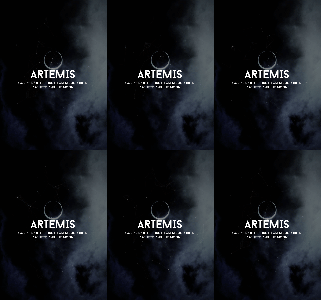
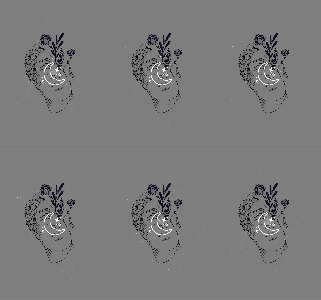

Greek Myth: Goddesses - Artemis ☾
↳ Artemis was one of the most widely venerated of the Ancient Greek deities. Her roman equivalent is Diana. Homer refers to her as Artemis Agrotera, Potnia Theron: “Artemis of the wildland, Mistress of Animals”. In the classical period of Greek mythology, Artemis was often described as the daughter of Zeus and Leto, and the twin sister of Apollo.
Gun Terms for Writers
As someone who writes fics with action sequences and the use of guns, I thought maybe it would be helpful to pass some things on. Even though I’ve done lots of research and talked with family members (I live in WI which is a big hunting state and we have lots of guns), I still catch myself making mistakes with specific terms and their usage. Reading more James Bond fics lately, I catch others making mistakes also. So here is a little guide to help writers.
- A ‘clip’ is something that stores multiple rounds of ammunition. It is not what you would insert into a handgun to load it. Clips make loading into a magazine easier because they simply store the rounds. It helps with organization.
- A magazine is what feeds the ammunition into the barrel. Magazines vary in capacity. They, unlike clips, are spring-loaded, which helps the ammunition move in the gun. So, when you want a character to reload, they would use a pre-loaded magazine, NOT a clip.
- A silencer is really a suppressor. ‘Silencer’ is a word that’s used in media to refer to a suppressor that doesn’t exist in real life. Guns that are suppressed will still be loud and have a sound. This is because compressed air will still leak out of the end of the barrel, you can’t silence a bullet moving extremely fast through the air, and you can’t silence the mechanical parts on a gun. There will be a noise, but it just won’t be as loud or more importantly, alert people in a nearby area that a gun was just fired. SO suppressor is a much more accurate term technically speaking.
- There are different kinds of suppressors. One important kind suppresses the muzzle flash. It’s likely a sniper would use this more than they would want to use a sound suppressor, as the muzzle flash more easily enables you to be spotted when you don’t want to be. These are simply referred to as flash suppressors.
- After a handgun runs out of ammunition, the slide will lock back into place and you will know that it is out. There is no ‘click’ signifying an empty weapon that is so dramatized in movies and tv. A more likely scenario that would prevent a gun from firing would be a jam. Or programming the gun to recognize certain palm prints.
- A great place for writers, in particular fanfic writers, who want information on guns is imfdb. You can find out what guns are used in movies and shows, and what guns characters use. You can also just search for guns.
- If you want to get really specific, check out YouTube. There are users who will post reviews of guns on there, which can be really helpful if you want to see how a particular gun looks or how to shoot it.
So yeah! Here are just a few basic tips if you want to write a fic where a character uses guns.
I see you’ve got terminology down, now let’s go for a little technicality.
- Firstly, let me explain the “kick” of a gun. A “kick” is the feeling of the round leaving the barrel of the gun. Every gun has one, the impact of the “kick” depends on the caliber, make and type of gun.
- Another way to describe a kick is the feeling of the gun exploding in your hand. Of course, the gun doesn’t literally explode, but it is a great burst of power that only lasts a second.
- For example: A .45 mm hand gun with have a bigger “kick” than a .22 mm hand gun. If someone is a first time shooter and does not know what to expect, they would most likely drop the gun after firing it once due to the shock of the force being released in their hands.
- Sniper Rifles are incredibly accurate and mainly used for long distance hits. They are also ridiculously heavy, as most rifles are, therefore, be prepared for a gigantic “kick”.
- Sniper Rifles are special because they are so powerful (they need to be in order to have the same impact a .45mm would 10 feet away compared to the shell half a mile away), thus a stand is required to use it.
- No matter what you will always need a firm holding to place the rifle (besides your grip) in order to prevent the gun from falling over after it is discharged and injury to your person. There are ridiculously powerful guns.
- General rule of thumb is that you place the butt of the rifle next to your shoulder, just below your clavicle. I’m not very good at describing this position, so I suggest looking it up. DO NOT place it anywhere in the armpit area, dislocation is likely to occur. Depending on how prepare you are and the type of rifle being used (excluding snipers), bruising might occur.
- You will be standing if you use a normal rifle, so make sure you are steady and prepared for the “kick” that follows after.
- If you are using a sniper rifle, you will be on the ground or leaning against something. Some people have special rests for their snipers specifically to fire the gun from any spot. Point is: do not stand alone while firing this. You will get hurt.
Other helpful tips:
- Earplugs or Ear Protectors are your friends.
- Safety glasses are also your friend to avoid shells from flying into your face.
- Keep the safety on until you are ready to fire the gun.
- If you are NOT currently firing the gun, whether it is loaded or unloaded, and it is in your hand, ALWAYS hold it with two hands and point it at the ground at your feet. DO NOT get distracted.
- NEVER joke around with someone by pointing the gun at them. EVEN IF YOU ARE ABSOLUTELY POSITIVE THAT THE GUN IS TOTALLY UNLOADED, MAGAZINE OUT OF PLACE, DO NOT RISK IT. It is not funny. Even if the gun is on safety, do NOT do it. You could accidently switch off the safety or the gun could misfire despite the safety.
- Lastly TWO HANDS. One on the side near the trigger and the other underneath. This is not the movies, do not attempt to fire a gun with one hand. Not only will your aim be incredibly off if you are inexperienced but you will also endanger yourself as well as others if you lose control of it.
- Guns can be scary and if you ever feel nervous or uncomfortable about firing one, do not do it.
A few things I have to add to this:
The caliber of a round is usually measured in either millimeters or in hundredths of an inch. One “unit” of caliber, I guess, is one one-hundredth of an inch. For example, a 45-caliber round has a .45 inch diameter (which is why it’s called a .45). DO NOT CONFUSE THIS WITH MILLIMETERS. .45 mm is NOT 45-caliber.
Common cartridges measured in millimeters with their respective calibers:
Rifles:
- 5.56mm = ~.223 caliber
- 7.62mm = ~.300 caliber
- 12.7mm = ~.500 caliber
Handguns:
- 5.64mm = .22 caliber*
- 9mm* = .354 caliber
- 10.16mm = .40 caliber*
- 11.43mm = .45 caliber*
(*the measurement you’re more likely to see for each cartridge.)
In the case of rifles, cartridges meant for civilian use are usually designated as .223, .300, .308, etc. Designations such as 5.56mm, 7.62mm, etc. are usually indicative of military-grade ammunition. This is not always true, but usually that’s how it is.
Military-grade bullets are held to higher standards and typically cause more stress on the internal mechanism, and the guns they’re meant for are built to handle that. They can also handle civilian ammunition. It doesn’t work the other way around, however. Do not attempt to use military-grade ammunition in a civilian-model firearm that hasn’t been modified to handle it.
A few different kinds of cartridges:
– Full metal jacket, which gives increased penetration capabilities but doesn’t do much in the ways of expansion. Risky to use in situations with a lot of innocents around, as often they can over-penetrate and go on to hurt someone behind the target.
– Hollow-points, which expand like crazy when they hit something, causing massive internal damage to their target. Outlawed in warfare under the Hague Convention of 1899, but can be used by civilians.
– Soft-points, which serve as a happy medium between the penetration capabilities of full metal jacket rounds and the expansion of hollow-point rounds.
– Shot, usually rat-shot or snake-shot, which can be fit in bullets and used to kill small vermin at close range without doing a whole lot of damage to the surrounding area.
– Sub-sonic, which have a lower muzzle velocity and effective range, but will decrease the chance of overpenetration. This is also the ideal ammo choice for weapons fitted with suppressors, as subsonic rounds avoid the “crack” of a sonic boom that other bullets can make upon leaving the barrel.
41 Emotions as Expressed through Body Language
Found Here x
41 Emotions as Expressed through Body Language unique
This list, while exhausting, is soooo not exhaustive; it barely scratches the surface. And each entry could easily become cliché (if it isn’t already). But, it should be enough to get you started. Want more? Start watching people (not in a creepy way), and take notes of what they seem to do when expressing different emotions. Your repertoire of expression will double in no time. PS—do not use these for actual, real-life body language reading; you will fail. These are strictly novelistic.Awed
-Slack
-jawed, raised eyebrows, staring
-Frozen, slack body language (Self? What self? There is only Zuul.)
-Take a step back and put a hand to his heartAmused
-Smiling and throwing back her head laughing
-Slapping her thighs, stamping her feet, clapping her hands
-Shaking her head (That’s so wrong!)Angry/Aggressive
-Sharp movements, like shaking a fist, pointing, slashing, or slamming a fist on a table
-Flushed face, patchy red blotches
-Tension in neck—chords standing out, veins throbbing—and jutting or tucked chin
-Arms akimbo, or clenching fists
-Entering someone else’s space and forcing them out
-Poofing up with a wide stance (I am big! Very big!), arms wide (Bring it!)
-Lowered eyebrows, squinting eyes
-Teeth bared, jaw clenched, snarlingAnnoyed
-Pressing lips together into a thin line
-Narrowing eyes sometimes with slight head tilt (Why do you still exist?)
-Rolling eyes, often paired with a long-suffering sighAnxious
-Fidgeting, such as tearing grass into little pieces, playing with a ring, or chewing on a pencil
-Biting lower lip, swallowing unnecessarily
-Quickened breathing or holding breath
-Darting eyes
-Pallor, sweating, clammy palms
-Unusually high-pitched, “nervous” laughter
-Hunched shoulders
-PacingAttentive
-Slow head nodding with a furrowed brow
-Leaning forward, toward the speaker, and sitting up
-Taking notes
-Looking over the top of her glassesBored
-Resting his head on his palm, peeking out between the fingers, maybe even slipping so his head “accidentally” hits the table
-Tapping toes, twirling pencil, doodling, and otherwise fidgeting
-Staring out a window, or at anything remotely more interesting (Which is everything …)Confident
-Arms clasped behind body
-Head lifted, chest out, standing tall
-Walking briskly and making firm, precise movementsConfused
-Tilting head with narrowed eyes
-A furrowed brow
-ShruggingContempt/Superiority
-Lifted chin (The better to look down the nose.)
-Pursed lips, sneering, slight frown
-Circling a shoulder, stretching her neck, turning away—anything to indicate she doesn’t see the person as a threat or worthy of her attention
-Grabbing her lapels, or tucking her thumbs in her waistcoat (See this clothing? It is much nicer than yours.)
-Dismissive hand-wavingCynical/Sarcastic/Bitter
-Twisted lips or a half-smile
-Sneering, sometimes with shaking the head and other defensive body language
-Pressed lips with a slight frown
-Eye rollingDefensive
-Crossed arms, legs, crossed anything, really (Well, maybe not fingers … or eyes …)
-Arms out, palms forward (Stop!)
-Placing anything (sword, shield, book, backpack) in front of her bodyDisgusted
-Crinkling his nose
-Curling his lip and/or showing the tip of his tongue briefly
-Flinching back and interposing a shoulder or turning away
-Covering his nose, gagging, and squinting his eyes shut—hard—for a moment. (It assaults all the senses.)Displeased
-A plastered-on fake smile (You suck; but I can’t tell you that. So here: a fake smile! Enjoy.)
-Pouting or frowning (I’ll cry if you don’t give me what I want—don’t test me, I will!)
-Crossed arms and other defensive/frustrated body language (I will not let that terrible idea influence me!)Distressed
-Wide eyes and shallow, rapid breathing
-Beating the walls, or huddling into a corner
-Clasping hands over his head protectively
-Rocking himself
-Handwringing
-Running his hands through his hairEarnest/Passionate
-Leaning forward, nodding, wide eyes with strong eye contact and raised eyebrows
-Hand on heart, or presented palms-up, or otherwise visible
-A double-handed handshake (I really want to make sure you understand me!)Embarrassment
-Blushing
-Stammering
-Covering her face with her hands or bowing her head (I’m so embarrassed, I can’t look!)
-Difficulty maintaining eye contact, looking down and awayExcited/Anticipation
-Rubbing hands together (I can’t wait to get my hands on it!)
-Licking lips (It’s so close I can taste it!)
-A vigorous, pumping handshake (I can’t wait to get started!)
-Jumping up and down (Look at me being literal here! I am jumping for joy.)
-A wide and easy grinFlirty
-Eye play, like winking, looking up through the lashes, over the shoulder glances, and eye catching
-Preening, like hair flipping or smooth, clothing straightening, spine straightening, etc.
-Striking a cowboy pose, with his thumbs gripping his belt tightFrustrated
-Shaking his head (You are so wrong!)
-Massaging temples (My brain—it hurts.)
-Clasping his wrist in his opposite hand, behind his back (Bad arm! No biscuit.)
-Running his hands through his hair (All this frustration is making my hair mussy. I can feel it.)
-Grabbing onto something like armrests, or white-knuckled interdigitation (Restrain yourself!)Happy
-Smiling and laughing
-Eyes and nose crinkling
-Swinging her arms, spinning loosely, dancing, jumpingImpatience
-Quick head nodding (Get on with it!)
-Toe/finger tapping (Hear this? These are seconds. Wasted. Listening to you.)
-Sighing, checking the clock/sundial/freckles (Time. It is moving so slowly.)Jealous
-Tight lips, or a sour expression
-Narrow eyes locked on the perpetrator, to the point of a stare down
-Crossed arms, and additional frustrated, angry, possessive, or bitter body languageLying
-Scratching their nose, ear, neck, miscellaneous part of face
-Sudden change in behavior or demeanor, including shifty eye contact, lots of long blinking, shrugging
-Ill-timed smiles or laughter (This is how I normally smile, right? Right???)
-Additional anxiety body language
-Shaking head no while saying “yes” (I can’t believe I just lied.)
-Licking lips, covering mouth, touching mouth, etc.Overwhelmed
-Both palms to forehead, fingers splayed (This gives me a headache.)
-Covering eyes with one hand (If I can’t see the world, it can’t see me …)
-Eyes wide and staring into space, hands gripping the table in front of her (… Woah.)Playful/Friendly
-Winking
-Waggling eyebrows
-Tiny shoves or nudgePleasure
-Head tilted back, lips parted slightly, eyes wide or closed
-Slow, languorous movements, stretching (such as arching her neck or back)
-Slight flush, quickened breath and pulsePossessive
-Handshake with arm clasp
-Putting hands on or around someone’s shoulders, neck, waist, back, or even just the wall near them
-Standing in someone’s personal space, body positioned toward that person
-Any one-sided act of intimacy, like running a knuckle down someone’s cheek
-Staring down any who get too closeProud/Dominant
-Chin up, chest out, shoulders back
-A painfully hard handshake that not only squishes the bones, but also forces his hand on top
-Leaning back with his hands behind his head, and his feet up
-Strong, unblinking, focused eye contactReluctance/Resistance
-Arms crossed, sometimes with fists (Not happening.)
-Dragging feet (But I don’t wanna!)
-Pinching nose (You want me to do what now?)
-Clamping hands over ears (La la la la!)Sad/Upset
-Droopy body (and anything held, like a sword), bowed in shoulders, wrapping arms around self
-Slow movements with hesitation
-Bottom lip jutting out and/or quivering
-Crying, sobbing, body shaking, sniffling, wet eyesSecretive
-A tight-lipped smile (My lips are zipped.)
-Hiding her hands in her pockets (What has it got in its nasty little pocket?)
-Looking awayScared
-Hunched shoulders, shrinking back from others (Don’t hurt me!)
-Wide eyes and lifted eyebrows (The better to see them coming.)
-Shaking, trembling, or freezing
-Rocking from side to side, sometimes holding self (It’ll all be okay, self, it’ll all be okay.)Shame
-Slumped shoulders (Don’t look at me.)
-Trouble meeting your gaze, looking down and away
-Burying her face in her hands or bowing her head (I can’t face the world right now.)Shocked
-Hands covering her mouth, or mouth hanging open, sometimes with a gasp (If I had words, I would be saying them.)
-Freezing and staring with wide eyes and eyebrows raised (Diverting all resources toward staring.)
-Smacking a palm into his forehead (Clearly, my head isn’t working right, or I wouldn’t have seen that)Shy
-Avoids eye contact, or has only fleeting eye contact (Eye contact means you might speak to me.)
-Keeps a fair distance from everyone, and will back away if someone steps closer (Space invaders!)
-Folded arms, head down, and other defensive body language (If I make myself small, they can’t see me.)Smug
-Slight, close-lipped smile (occasionally one-sided) and sometimes one raised eyebrow (I know something you don’t know.)
-Chin slightly tucked, Mona Lisa smile, raised eyebrows (I know better.)
-Finger steepling (I am so smaaaht.)Suspicious/Skeptical/Disbelief
-Narrowed eyes, sometimes with a sidelong glance or raised eyebrow (Perhaps if I look at it out of the corner of my eye, I will catch it unawares.)
-Rubbing his eyes (I can’t believe what I’m metaphorically or literally seeing!)
-Shaking his head (I—I don’t believe it.)
-Blowing out cheeks (Well , I don’t know …)Tired
-Rubbing his eyes, eyes staring into space, raised eyebrows (Raising my eyebrows helps keep my eyes open.)
-Yawning and/or stretching (I am tired—see? Tired! Too tired to care!)
-Almost nodding off and jerking awake (Cannot. Stay. Awa—snnnnurzzzz.)
-Gritting teeth to stay awake (Cannot—yawn—dang it!)Thoughtfulness/Thinking
-Steepling fingers (I will think better if I center myself and focus.)
-Pinching nose, sometimes with closed eyes (Focus, focus—I just need to focus.)
-Tugging on an ear (This will help me remember!)
-Stroking a real or imaginary beard (People with beards look smart.)
-Furrowed brow, narrowed eyes, sometimes tilted head and pressing lips together (I can’t see it—I will try harder!)
-Resting his chin on his hand (Thinking makes my head heavy.)Triumphant
-Hands clenched and held above head while grimacing (She is invincible!)
-Head tilted back with a yell (She is fierce!)
-Arm pumping in the air, jumping (Woohoo!)
 #aesthetic